

If you are looking for information on the Nathan's Famous franchise business opportunity, Nathan's Famous hot dog franchises or Nathan's Famous hot dogs franchising, then you have come to the right place.

Franchising is a business concept that allows qualified investors to become part of an existing "system" providing multiple benefits under a trade name that has built strong customer awareness and brand equity. Nathan's has taken this basic premise and redefined it to meet and exceed the stringent business criteria of today's investor.
By offering a wide range of restaurant designs and customized equipment, we are able to provide a variety of business opportunities to qualified candidates regardless of space constraints or investment limitations.
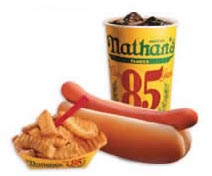 It began as a nickel hot dog stand in Coney Island in 1916 and grew to become the much-loved New York institution now available throughout the United States and overseas. Nathan's Famous recently entered a dynamic new stage, evolving from a company that owned and operated restaurants to a company that owns and markets brands.
For the majority of its 85 years, Nathan's focused on the sale of its products through fast-food restaurants. Recently, however, the company has implemented an aggressive strategy to expand the reach of its brand by diversifying product offerings and adopting an expanding points-of-distribution program.
Nathan's has reached out to its customers, offering its signature products through programs that are more profitable and less capital intensive. For example, today consumers are often delighted to find small Nathan's outlets situated within Home Depot improvement centers.

Nathan's has distinguished itself as going beyond industry standards in its support of its partners. From the initial evaluation of the site and determination of the menu and facility design, through the pre-opening procedures and for the entire term of our relationship, Nathan's is there to guide and support its partners with:
 Nathan's offers unparalleled quality food, over eighty years of successful marketing, flexibility in menu, design and a company you'll be proud being associated with.
You have the competitive advantage of operating your business under a trademark that has enormous brand equity and is a leader in its category.
Nathan's is there to support and guide you with site selection, lease negotiations, prototypical architectural plans, training, marketing, purchasing, inventory control and a great deal more.
There is extensive ongoing support. You will benefit from having a professional operations manager with you for up to two weeks at the opening of your restaurant. He will help train your crew and make sure you are comfortable in your new environment.
The information presented may have changed since first published. We recommend that you always verify fees, investment amounts and offers with the business opportunity directly prior to making a decision to invest.
1. What training and ongoing support do you provide?
You want to know what happens after you pay the initial fee. A strong franchisor provides comprehensive pre-opening training, site-selection help, operational playbooks, and continuous assistance with marketing, technology, and supply chains.
2. What is the total initial investment, and did actual startup costs match the estimates in Item 7 of the FDD?
The Franchise Disclosure Document (FDD) lists estimated startup costs in Item 7, but real-world expenses can run higher. Asking how closely current owners tracked to these estimates reveals if you need extra working capital or if hidden fees exist.
3. How do royalties and local/national marketing fees impact profitability?
You need to understand ongoing financial obligations-such as monthly royalty percentages and ad fund contributions-and evaluate whether the brand value and support justify cutting into your profit margins.
4. What are the common challenges new franchisees face, and how do you help them overcome them?
Transparent franchisors will openly discuss real hurdles like local competition, tight labor markets, or supply chain bottlenecks, and show you the exact playbook or field support they offer to solve them as well as allowing you to speak with other franchisees.
5. How many franchise locations have closed or left the system in the past few years, and why?
High turnover, store closures, or quiet franchise exits are major red flags. This question measures system stability, territory health, and whether the corporate team addresses struggling owners or lets them fail.

 Food and Beverage Franchises