

If you are looking for information on the Mr. Payroll franchise business opportunity, Mr. Payroll franchises or Mr. Payroll franchising, then you have come to the right place.

One of the most pressing needs of the "self-banked" is converting their hard earned paychecks into cash on payday. A recent Federal Reserve Bulletin estimated that 28% of all working-class households have the need for paycheck cashing services. Mr. Payroll is a multi-state network of check cashing locations either in store fronts or conveniently place within an existing retail center. These compact financial service centers provide fast and convenient check cashing, money orders, bill paying, money transfers and other necessary services at one location for a low cost.
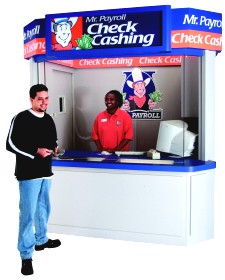 The combination of company-owned sites and independently owned franchised locations has spread this needed service to convenience stores in twenty states. Mr. Payroll sites occupy major oil company stores like TEXACO, CONOCO, BP and TOTAL to name a few. Additionally, Mr. Payroll kiosks are hosted by regional operators such as Toot 'n' Totum, Allsups, Cracker Barrel, EZ Mart and Jet 24. Franchised locations are owned by individuals as well as convenience store operators. The Mr. Payroll kiosk is a boon to the convenience store because it adds customers inside the store with cash in hand.
In these compact and secure units, a friendly cashier services the financial needs of the neighborhood with the use of a proprietary computer system that performs each transaction quickly and accurately. Repeat customers can cash their paycheck in less than a minute. Additional financial services are being added to the Mr. Payroll system. Almost 150 locations currently display the red, white and blue of Mr. Payroll's brightly colored sign.
When examining any franchise investment, it is important to gather the facts, analyze the risks and make an informed decision. The following facts will provide basic information on the growing demand for non-bank check cashing, the Mr. Payroll system and our strategy for serving this market.
There is much more to consider before either Mr. Payroll or you will be prepared to make a decision. You must be fully informed about all aspects of the franchise investment. We must know more about your capabilities and needs. The franchise discovery process we follow allows both parties to gather facts in an orderly manner.
By combining the information you will receive with your personal judgment and experience, you will be able to create a business plan, forecast and operating budget. Whether you are a C-store operator or you are interested in becoming an independent check casher in a host C-store, the Mr. Payroll program has the tools you need to be successful.
The information presented may have changed since first published. We recommend that you always verify fees, investment amounts and offers with the business opportunity directly prior to making a decision to invest.
1. What training and ongoing support do you provide?
You want to know what happens after you pay the initial fee. A strong franchisor provides comprehensive pre-opening training, site-selection help, operational playbooks, and continuous assistance with marketing, technology, and supply chains.
2. What is the total initial investment, and did actual startup costs match the estimates in Item 7 of the FDD?
The Franchise Disclosure Document (FDD) lists estimated startup costs in Item 7, but real-world expenses can run higher. Asking how closely current owners tracked to these estimates reveals if you need extra working capital or if hidden fees exist.
3. How do royalties and local/national marketing fees impact profitability?
You need to understand ongoing financial obligations-such as monthly royalty percentages and ad fund contributions-and evaluate whether the brand value and support justify cutting into your profit margins.
4. What are the common challenges new franchisees face, and how do you help them overcome them?
Transparent franchisors will openly discuss real hurdles like local competition, tight labor markets, or supply chain bottlenecks, and show you the exact playbook or field support they offer to solve them as well as allowing you to speak with other franchisees.
5. How many franchise locations have closed or left the system in the past few years, and why?
High turnover, store closures, or quiet franchise exits are major red flags. This question measures system stability, territory health, and whether the corporate team addresses struggling owners or lets them fail.

